
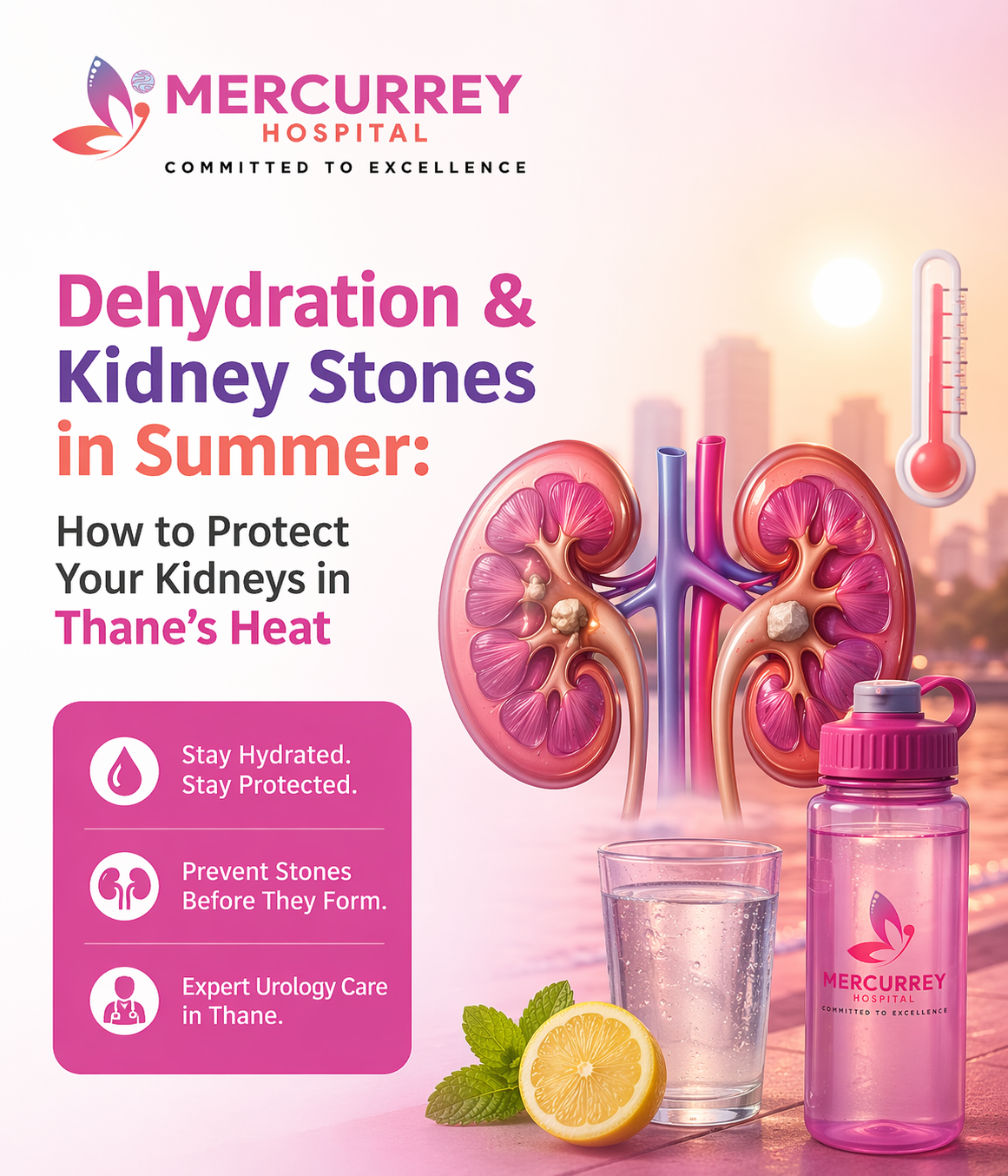
Every April, as Thane’s temperatures begin their relentless climb, hospitals across the city see a sharp and predictable rise in one particular emergency: kidney stones. It is not a coincidence.
The connection between summer heat, dehydration, and kidney stones is one of the most well-established relationships in urology. Yet year after year, thousands of people seeking kidney stone treatment in Thane arrive at the emergency room with agonising flank pain pain that could have been prevented with something as simple as drinking more water.
This blog from the expert urology treatment in Thane team at Mercurrey Hospital explains exactly why kidney stones form in summer, who is most at risk, what the warning signs are, and most importantly how to protect your kidneys during the hottest months of the year.
Why Summer in Thane Increases Kidney Stone Risk
Thane’s summers are intense. From April through June, temperatures regularly exceed 38 to 40 degrees Celsius, and humidity levels make it feel even hotter. In these conditions, the body loses significantly more fluid through sweat than it does in cooler months.
When you lose more fluid than you replace, your urine becomes more concentrated. Concentrated urine contains higher levels of minerals and salts including calcium, oxalate, uric acid, and phosphate. When these minerals accumulate beyond what the urine can dissolve, they begin to crystallise and clump together, forming kidney stones.
Research shows that kidney stone cases increase by 30 to 40 per cent during summer months in hot climates. In cities like Thane, where high humidity adds to the heat load, dehydration happens faster than most people realise — even when you are indoors.
The process can happen surprisingly quickly. Going just 24 to 48 hours with insufficient fluid intake during peak summer heat is enough to create the conditions for stone formation, especially if you are already prone to them. This is why timely kidney stone treatment in Thane becomes critically important during summer.
What Are Kidney Stones? A Quick Overview
Kidney stones (medically called nephrolithiasis or renal calculi) are hard deposits of minerals and salts that form inside the kidneys. They vary in size from a tiny grain of sand to a golf ball, though even small stones can cause severe pain when they pass through the urinary tract.
As a leading centre for urology treatment in Thane, Mercurrey Hospital regularly treats all four main types of kidney stones:
- Calcium oxalate stones — the most common type (75–80%), forming when calcium combines with oxalate in concentrated urine.
- Uric acid stones — form when urine is too acidic, often linked to a high-protein diet or gout.
- Struvite stones — associated with urinary tract infections, more common in women.
- Cystine stones — rare, caused by a genetic condition affecting amino acid absorption.
In summer, calcium oxalate and uric acid stones are the types most strongly linked to dehydration and heat exposure and the most common reasons patients seek kidney stone treatment in Thane.
Who Is Most at Risk of Kidney Stones in Summer?
While anyone can develop kidney stones, some people face significantly higher risk during the summer months:
- People who work outdoors — construction workers, delivery drivers, farmers, and labourers in Thane who spend long hours in the heat lose far more fluid than desk workers.
- People who exercise heavily outdoors — runners, cyclists, and gym-goers who sweat heavily without adequate hydration.
- Those with a history of kidney stones — if you have had a stone before, your risk of recurrence is approximately 50 per cent within 10 years. Summer dramatically increases this risk.
- People on high-protein or high-sodium diets — both increase urinary calcium and uric acid levels.
- Individuals with diabetes or obesity — both conditions alter urine chemistry in ways that promote stone formation.
- Men between the ages of 30 and 50 — statistically the most common kidney stone demographic in India.
- People taking certain medications — including diuretics, calcium-based antacids, and some antibiotics.
Air-conditioned offices can also create a false sense of hydration you may not feel thirsty even as your body steadily loses fluid throughout the day.
Warning Signs of Kidney Stones: When to Seek Urology Treatment in Thane
Kidney stones do not always cause symptoms small stones may pass unnoticed. But when a stone becomes large enough to obstruct the urinary tract, the pain can be sudden and excruciating. If you notice any of the following, it is time to seek urology treatment in Thane at Mercurrey Hospital:
- Severe, cramping pain in the back or side below the ribs
- Pain that radiates to the lower abdomen and groin
- Burning sensation or pain during urination
- Pink, red, or brown urine (blood in urine)
- Cloudy or foul-smelling urine
- Nausea and vomiting
- Frequent urge to urinate or reduced urine output
- Fever and chills (this is a medical emergency seek immediate care)
Important: If you experience severe back or groin pain combined with fever, chills, nausea, or vomiting — visit Mercurrey Hospital’s Emergency Department immediately. These symptoms together may indicate a kidney infection or an obstructed kidney, both of which require urgent kidney stone treatment in Thane.
Kidney Stone Treatment in Thane at Mercurrey Hospital
Mercurrey Hospital is one of the most trusted destinations for kidney stone treatment in Thane and comprehensive urology treatment in Thane. Here is how our specialists diagnose and treat kidney stones.
How Kidney Stones Are Diagnosed
- Ultrasound of the kidneys, ureters, and bladder — the first-line investigation, radiation-free and highly effective.
- CT scan (non-contrast) — the gold standard for detecting even small stones; available in-house at Mercurrey Hospital.
- Urine analysis and culture — to check for infection and analyse stone-forming minerals.
- Blood tests — to evaluate kidney function, calcium levels, and uric acid.
- 24-hour urine collection — for recurrent stone patients, to identify the specific metabolic cause.
Treatment Options
- Conservative management — small stones (less than 5mm) often pass on their own with increased fluid intake and pain management.
- Medical expulsive therapy — medications such as alpha-blockers help relax the ureter, making it easier for stones to pass naturally.
- ESWL (Extracorporeal Shock Wave Lithotripsy) — a non-invasive procedure using sound waves to break stones into smaller fragments; a preferred option in kidney stone treatment in Thane for suitable candidates.
- Ureteroscopy with laser lithotripsy — a minimally invasive procedure where a thin scope locates and breaks the stone using a laser; a cornerstone of advanced urology treatment in Thane.
- PCNL (Percutaneous Nephrolithotomy) — a minimally invasive surgical approach for large or complex stones.
- Open surgery — reserved for very rare, complex cases.
Our Nephrology and Urology teams work together to address the underlying metabolic causes of kidney stones — not just the stone itself. This integrated approach to urology treatment in Thane helps significantly reduce your risk of recurrence.
How Much Water Should You Drink in Thane’s Summer?
The most powerful and completely free tool to prevent kidney stones is water. The goal is to produce at least 2 to 2.5 litres of urine per day, which typically requires drinking significantly more than the standard eight-glass recommendation during summer.
| Person | Daily Water Intake |
| Sedentary adult (office work) | 2.5 to 3 litres (10–12 glasses) |
| Active adult or outdoor worker | 3 to 4 litres (12–16 glasses) |
| Post kidney stone treatment patient | 3.5 to 4 litres (14–16 glasses) |
| Children aged 6 to 12 years | 1.5 to 2 litres (6–8 glasses) |
| Elderly adults (60+ years) | 2 to 2.5 litres (8–10 glasses) |
The Urine Colour Test
The easiest way to know if you are drinking enough is to check your urine colour:
- Pale yellow or clear — well hydrated
- Dark yellow — mildly dehydrated; drink water now
- Amber or brown — significantly dehydrated; rest and rehydrate immediately
- Pink or red — may indicate blood in the urine; seek urology treatment in Thane at Mercurrey Hospital today
10 Practical Tips to Prevent Kidney Stones This Summer
These tips come from the urology treatment in Thane specialists at Mercurrey Hospital:
- Drink water consistently throughout the day do not wait until you are thirsty. Thirst is already a sign of mild dehydration.
- Start your morning with 2 large glasses of water before tea or coffee.
- Carry a water bottle at all times keep one on your desk, in your bag, and in your vehicle.
- Eat water-rich fruits and vegetables cucumber, watermelon, oranges, and tomatoes all contribute to your daily fluid intake.
- Limit salt intake high sodium increases calcium in the urine. Avoid packaged snacks, papad, pickles, and fast food.
- Reduce animal protein red meat, poultry, and eggs raise uric acid levels. Moderate your intake during summer.
- Limit oxalate-rich foods if you have had calcium oxalate stones spinach, beetroot, nuts, chocolate, and tea in high quantities can increase risk.
- Add lemon to your water the citrate in lemon juice helps inhibit kidney stone formation naturally.
- Avoid sugary drinks and sodas they are dehydrating and some increase urinary oxalate and calcium.
- Schedule a kidney stone check-up with the urology treatment in Thane team at Mercurrey Hospital — a simple ultrasound and urine test before summer peaks can detect problems early.
Foods That Protect Your Kidneys in Summer
Include these kidney-friendly foods:
- Watermelon — over 90% water content; helps flush the kidneys and is perfect for Thane’s summer heat.
- Coconut water — naturally hydrating, rich in potassium, helps maintain electrolyte balance.
- Lemon water — citrate content helps prevent kidney stones naturally.
- Cucumber — extremely hydrating, low in oxalate, and a natural diuretic.
- Pomegranate — contains antioxidants that support kidney health.
- Barley water (jau ka paani) — a traditional remedy with scientific backing; increases urine output and flushes out mineral deposits.
- Low-fat dairy — moderate calcium from food sources actually helps prevent kidney stones by binding oxalate in the gut.
Limit these foods during summer if you are stone-prone:
- Spinach, drumstick leaves, and amaranth (high in oxalate)
- Excessive red meat and organ meats (raise uric acid)
- Nuts and seeds in large quantities (high oxalate)
- Table salt and high-sodium processed foods
- Vitamin C supplements in high doses (convert to oxalate in the body)
Can Dehydration Cause Kidney Damage Beyond Stones?
Yes — and this is a point often overlooked by patients who delay seeking help. Chronic dehydration does not just cause kidney stones. Over time, it can also cause:
- Acute kidney injury (AKI) — a sudden loss of kidney function, particularly in elderly patients or those with existing kidney disease.
- Urinary tract infections (UTIs) — low urine flow allows bacteria to multiply in the bladder and urinary tract.
- Chronic kidney disease (CKD) progression — summer dehydration can accelerate decline in patients already managing CKD.
- Electrolyte imbalances — affecting heart rhythm, blood pressure, and muscle function.
If you have been diagnosed with CKD or have diabetes with kidney involvement, summer in Thane requires extra vigilance. Your specialist at Mercurrey Hospital may need to adjust your fluid intake, medications, and monitoring schedule for the summer months.
Conclusion
Kidney stones in summer are largely preventable. The science is clear: staying well hydrated, watching your diet, and being aware of your personal risk factors can dramatically reduce your chances of experiencing that dreaded flank pain on a hot April afternoon.
Prevention only works when you are informed and kidney stone treatment in Thane works best when you act early. If you experience any symptoms of kidney stones, or simply want a kidney health check before summer peaks, the urology treatment in Thane specialists at Mercurrey Hospital are ready to help.
Do not let this summer be the one that lands you in the emergency room. Stay hydrated, eat smart, and trust your kidneys to the expert team at Mercurrey Hospital.